Friday, October 1, 2010

C.I.A.'s SECRET INTERROGATION PROGRAM - Part II

The Black Sites

A rare look inside the C.I.A.’s secret interrogation program.

by Jane MayerAUGUST 13, 2007


The C.I.A. knew even less about running prisons than it did about hostile interrogations. Tyler Drumheller, a former chief of European operations at the C.I.A., and the author of a recent book, “On the Brink: How the White House Compromised U.S. Intelligence,” said, “The agency had no experience in detention. Never. But they insisted on arresting and detaining people in this program. It was a mistake, in my opinion. You can’t mix intelligence and police work. But the White House was really pushing. They wanted someone to do it. So the C.I.A. said, ‘We’ll try.’ George Tenet came out of politics, not intelligence. His whole modus operandi was to please the principal. We got stuck with all sorts of things. This is really the legacy of a director who never said no to anybody.”

Many officials inside the C.I.A. had misgivings. “A lot of us knew this would be a can of worms,” the former officer said. “We warned them, It’s going to become an atrocious mess.” The problem from the start, he said, was that no one had thought through what he called “the disposal plan.” He continued, “What are you going to do with these people? The utility of someone like K.S.M. is, at most, six months to a year. You exhaust them. Then what? It would have been better if we had executed them.”

The C.I.A. program’s first important detainee was Abu Zubaydah, a top Al Qaeda operative, who was captured by Pakistani forces in March of 2002. Lacking in-house specialists on interrogation, the agency hired a group of outside contractors, who implemented a regime of techniques that one well-informed former adviser to the American intelligence community described as “a ‘Clockwork Orange’ kind of approach.” The experts were retired military psychologists, and their backgrounds were in training Special Forces soldiers how to survive torture, should they ever be captured by enemy states. The program, known as SERE—an acronym for Survival, Evasion, Resistance, and Escape—was created at the end of the Korean War. It subjected trainees to simulated torture, including waterboarding (simulated drowning), sleep deprivation, isolation, exposure to temperature extremes, enclosure in tiny spaces, bombardment with agonizing sounds, and religious and sexual humiliation. The SERE program was designed strictly for defense against torture regimes, but the C.I.A.’s new team used its expertise to help interrogators inflict abuse. “They were very arrogant, and pro-torture,” a European official knowledgeable about the program said. “They sought to render the detainees vulnerable—to break down all of their senses. It takes a psychologist trained in this to understand these rupturing experiences.”

The use of psychologists was also considered a way for C.I.A. officials to skirt measures such as the Convention Against Torture. The former adviser to the intelligence community said, “Clearly, some senior people felt they needed a theory to justify what they were doing. You can’t just say, ‘We want to do what Egypt’s doing.’ When the lawyers asked what their basis was, they could say, ‘We have Ph.D.s who have these theories.’ ” He said that, inside the C.I.A., where a number of scientists work, there was strong internal opposition to the new techniques. “Behavioral scientists said, ‘Don’t even think about this!’ They thought officers could be prosecuted.”

Nevertheless, the SERE experts’ theories were apparently put into practice with Zubaydah’s interrogation. Zubaydah told the Red Cross that he was not only waterboarded, as has been previously reported; he was also kept for a prolonged period in a cage, known as a “dog box,” which was so small that he could not stand. According to an eyewitness, one psychologist advising on the treatment of Zubaydah, James Mitchell, argued that he needed to be reduced to a state of “learned helplessness.” (Mitchell disputes this characterization.)

Steve Kleinman, a reserve Air Force colonel and an experienced interrogator who has known Mitchell professionally for years, said that “learned helplessness was his whole paradigm.” Mitchell, he said, “draws a diagram showing what he says is the whole cycle. It starts with isolation. Then they eliminate the prisoners’ ability to forecast the future—when their next meal is, when they can go to the bathroom. It creates dread and dependency. It was the K.G.B. model. But the K.G.B. used it to get people who had turned against the state to confess falsely. The K.G.B. wasn’t after intelligence.”

As the C.I.A. captured and interrogated other Al Qaeda figures, it established a protocol of psychological coercion. The program tied together many strands of the agency’s secret history of Cold War-era experiments in behavioral science. (In June, the C.I.A. declassified long-held secret documents known as the Family Jewels, which shed light on C.I.A. drug experiments on rats and monkeys, and on the infamous case of Frank R. Olson, an agency employee who leaped to his death from a hotel window in 1953, nine days after he was unwittingly drugged with LSD.) The C.I.A.’s most useful research focussed on the surprisingly powerful effects of psychological manipulations, such as extreme sensory deprivation. According to Alfred McCoy, a history professor at the University of Wisconsin, in Madison, who has written a history of the C.I.A.’s experiments in coercing subjects, the agency learned that “if subjects are confined without light, odors, sound, or any fixed references of time and place, very deep breakdowns can be provoked.”

Agency scientists found that in just a few hours some subjects suspended in water tanks—or confined in isolated rooms wearing blacked-out goggles and earmuffs—regressed to semi-psychotic states. Moreover, McCoy said, detainees become so desperate for human interaction that “they bond with the interrogator like a father, or like a drowning man having a lifesaver thrown at him. If you deprive people of all their senses, they’ll turn to you like their daddy.” McCoy added that “after the Cold War we put away those tools. There was bipartisan reform. We backed away from those dark days. Then, under the pressure of the war on terror, they didn’t just bring back the old psychological techniques—they perfected them.”

The C.I.A.’s interrogation program is remarkable for its mechanistic aura. “It’s one of the most sophisticated, refined programs of torture ever,” an outside expert familiar with the protocol said. “At every stage, there was a rigid attention to detail. Procedure was adhered to almost to the letter. There was top-down quality control, and such a set routine that you get to the point where you know what each detainee is going to say, because you’ve heard it before. It was almost automated. People were utterly dehumanized. People fell apart. It was the intentional and systematic infliction of great suffering masquerading as a legal process. It is just chilling.”

The U.S. government first began tracking Khalid Sheikh Mohammed in 1993, shortly after his nephew Ramzi Yousef blew a gaping hole in the World Trade Center. Mohammed, officials learned, had transferred money to Yousef. Mohammed, born in either 1964 or 1965, was raised in a religious Sunni Muslim family in Kuwait, where his family had migrated from the Baluchistan region of Pakistan. In the mid-eighties, he was trained as a mechanical engineer in the U.S., attending two colleges in North Carolina.

As a teen-ager, Mohammed had been drawn to militant, and increasingly violent, Muslim causes. He joined the Muslim Brotherhood at the age of sixteen, and, after his graduation from North Carolina Agricultural and Technical State University, in Greensboro—where he was remembered as a class clown, but religious enough to forgo meat when eating at Burger King—he signed on with the anti-Soviet jihad in Afghanistan, receiving military training and establishing ties with Islamist terrorists. By all accounts, his animus toward the U.S. was rooted in a hatred of Israel.

In 1994, Mohammed, who was impressed by Yousef’s notoriety after the first World Trade Center bombing, joined him in scheming to blow up twelve U.S. jumbo jets over two days. The so-called Bojinka plot was disrupted in 1995, when Philippine police broke into an apartment that Yousef and other terrorists were sharing in Manila, which was filled with bomb-making materials. At the time of the raid, Mohammed was working in Doha, Qatar, at a government job. The following year, he narrowly escaped capture by F.B.I. officers and slipped into the global jihadist network, where he eventually joined forces with Osama bin Laden, in Afghanistan. Along the way, he married and had children.

Many journalistic accounts have presented Mohammed as a charismatic, swashbuckling figure: in the Philippines, he was said to have flown a helicopter close enough to a girlfriend’s office window so that she could see him; in Pakistan, he supposedly posed as an anonymous bystander and gave interviews to news reporters about his nephew’s arrest. 

Neither story is true. But Mohammed did seem to enjoy taunting authorities after the September 11th attacks, which, in his eventual confession, he claimed to have orchestrated “from A to Z.” In April, 2002, Mohammed arranged to be interviewed on Al Jazeera by its London bureau chief, Yosri Fouda, and took personal credit for the atrocities. “I am the head of the Al Qaeda military committee,” he said. “And yes, we did it.” Fouda, who conducted the interview at an Al Qaeda safe house in Karachi, said that he was astounded not only by Mohammed’s boasting but also by his seeming imperviousness to the danger of being caught. Mohammed permitted Al Jazeera to reveal that he was hiding out in the Karachi area. When Fouda left the apartment, Mohammed, apparently unarmed, walked him downstairs and out into the street.

In the early months of 2003, U.S. authorities reportedly paid a twenty-five-million-dollar reward for information that led to Mohammed’s arrest. U.S. officials closed in on him, at 4 A.M. on March 1st, waking him up in a borrowed apartment in Rawalpindi, Pakistan. The officials hung back as Pakistani authorities handcuffed and hooded him, and took him to a safe house. Reportedly, for the first two days, Mohammed robotically recited Koranic verses and refused to divulge much more than his name. A videotape obtained by “60 Minutes” shows Mohammed at the end of this episode, complaining of a head cold; an American voice can be heard in the background. This was the last image of Mohammed to be seen by the public. By March 4th, he was in C.I.A. custody.

Captured along with Mohammed, according to some accounts, was a letter from bin Laden, which may have led officials to think that he knew where the Al Qaeda founder was hiding. If Mohammed did have this crucial information, it was time sensitive—bin Laden never stayed in one place for long—and officials needed to extract it quickly. At the time, many American intelligence officials still feared a “second wave” of Al Qaeda attacks, ratcheting the pressure further.

According to George Tenet’s recent memoir, “At the Center of the Storm,” Mohammed told his captors that he wouldn’t talk until he was given a lawyer in New York, where he assumed he would be taken. (He had been indicted there in connection with the Bojinka plot.) Tenet writes, “Had that happened, I am confident that we would have obtained none of the information he had in his head about imminent threats against the American people.” Opponents of the C.I.A.’s approach, however, note that Ramzi Yousef gave a voluminous confession after being read his Miranda rights. “These guys are egomaniacs,” a former federal prosecutor said. “They love to talk!”

A complete picture of Mohammed’s time in secret detention remains elusive. But a partial narrative has emerged through interviews with European and American sources in intelligence, government, and legal circles, as well as with former detainees who have been released from C.I.A. custody. People familiar with Mohammed’s allegations about his interrogation, and interrogations of other high-value detainees, describe the accounts as remarkably consistent.

Soon after Mohammed’s arrest, sources say, his American captors told him, “We’re not going to kill you. But we’re going to take you to the very brink of your death and back.” He was first taken to a secret U.S.-run prison in Afghanistan. According to a Human Rights Watch report released two years ago, there was a C.I.A.-affiliated black site in Afghanistan by 2002: an underground prison near Kabul International Airport. Distinctive for its absolute lack of light, it was referred to by detainees as the Dark Prison. Another detention facility was reportedly a former brick factory, just north of Kabul, known as the Salt Pit. The latter became infamous for the 2002 death of a detainee, reportedly from hypothermia, after prison officials stripped him naked and chained him to the floor of his concrete cell, in freezing temperatures.

In all likelihood, Mohammed was transported from Pakistan to one of the Afghan sites by a team of black-masked commandos attached to the C.I.A.’s paramilitary Special Activities Division. According to a report adopted in June by the Parliamentary Assembly of the Council of Europe, titled “Secret Detentions and Illegal Transfers of Detainees,” detainees were “taken to their cells by strong people who wore black outfits, masks that covered their whole faces, and dark visors over their eyes.” (Some personnel reportedly wore black clothes made from specially woven synthetic fabric that couldn’t be ripped or torn.) A former member of a C.I.A. transport team has described the “takeout” of prisoners as a carefully choreographed twenty-minute routine, during which a suspect was hog-tied, stripped naked, photographed, hooded, sedated with anal suppositories, placed in diapers, and transported by plane to a secret location.

A person involved in the Council of Europe inquiry, referring to cavity searches and the frequent use of suppositories during the takeout of detainees, likened the treatment to “sodomy.” He said, “It was used to absolutely strip the detainee of any dignity. It breaks down someone’s sense of impenetrability. The interrogation became a process not just of getting information but of utterly subordinating the detainee through humiliation.” The former C.I.A. officer confirmed that the agency frequently photographed the prisoners naked, “because it’s demoralizing.” The person involved in the Council of Europe inquiry said that photos were also part of the C.I.A.’s quality-control process. They were passed back to case officers for review.

A secret government document, dated December 10, 2002, detailing “SERE Interrogation Standard Operating Procedure,” outlines the advantages of stripping detainees. “In addition to degradation of the detainee, stripping can be used to demonstrate the omnipotence of the captor or to debilitate the detainee.” The document advises interrogators to “tear clothing from detainees by firmly pulling downward against buttoned buttons and seams. Tearing motions shall be downward to prevent pulling the detainee off balance.” The memo also advocates the “Shoulder Slap,” “Stomach Slap,” “Hooding,” “Manhandling,” “Walling,” and a variety of “Stress Positions,” including one called “Worship the Gods.”

In the process of being transported, C.I.A. detainees such as Mohammed were screened by medical experts, who checked their vital signs, took blood samples, and marked a chart with a diagram of a human body, noting scars, wounds, and other imperfections. As the person involved in the Council of Europe inquiry put it, “It’s like when you hire a motor vehicle, circling where the scratches are on the rearview mirror. Each detainee was continually assessed, physically and psychologically.”

According to sources, Mohammed said that, while in C.I.A. custody, he was placed in his own cell, where he remained naked for several days. He was questioned by an unusual number of female handlers, perhaps as an additional humiliation. He has alleged that he was attached to a dog leash, and yanked in such a way that he was propelled into the walls of his cell. Sources say that he also claimed to have been suspended from the ceiling by his arms, his toes barely touching the ground. The pressure on his wrists evidently became exceedingly painful.

Ramzi Kassem, who teaches at Yale Law School, said that a Yemeni client of his, Sanad al-Kazimi, who is now in Guantánamo, alleged that he had received similar treatment in the Dark Prison, the facility near Kabul. Kazimi claimed to have been suspended by his arms for long periods, causing his legs to swell painfully. “It’s so traumatic, he can barely speak of it,” Kassem said. “He breaks down in tears.” Kazimi also claimed that, while hanging, he was beaten with electric cables.

According to sources familiar with interrogation techniques, the hanging position is designed, in part, to prevent detainees from being able to sleep. The former C.I.A. officer, who is knowledgeable about the interrogation program, explained that “sleep deprivation works. Your electrolyte balance changes. You lose all balance and ability to think rationally. Stuff comes out.” Sleep deprivation has been recognized as an effective form of coercion since the Middle Ages, when it was called tormentum insomniae. It was also recognized for decades in the United States as an illegal form of torture. An American Bar Association report, published in 1930, which was cited in a later U.S. Supreme Court decision, said, “It has been known since 1500 at least that deprivation of sleep is the most effective torture and certain to produce any confession desired.”

Under President Bush’s new executive order, C.I.A. detainees must receive the “basic necessities of life, including adequate food and water, shelter from the elements, necessary clothing, protection from extremes of heat and cold, and essential medical care.” Sleep, according to the order, is not among the basic necessities.

In addition to keeping a prisoner awake, the simple act of remaining upright can over time cause significant pain. McCoy, the historian, noted that “longtime standing” was a common K.G.B. interrogation technique. In his 2006 book, “A Question of Torture,” he writes that the Soviets found that making a victim stand for eighteen to twenty-four hours can produce “excruciating pain, as ankles double in size, skin becomes tense and intensely painful, blisters erupt oozing watery serum, heart rates soar, kidneys shut down, and delusions deepen.”

Mohammed is said to have described being chained naked to a metal ring in his cell wall for prolonged periods in a painful crouch. (Several other detainees who say that they were confined in the Dark Prison have described identical treatment.) He also claimed that he was kept alternately in suffocating heat and in a painfully cold room, where he was doused with ice water. The practice, which can cause hypothermia, violates the Geneva Conventions, and President Bush’s new executive order arguably bans it.

Some detainees held by the C.I.A. claimed that their cells were bombarded with deafening sound twenty-fours hours a day for weeks, and even months. One detainee, Binyam Mohamed, who is now in Guantánamo, told his lawyer, Clive Stafford Smith, that speakers blared music into his cell while he was handcuffed. Detainees recalled the sound as ranging from ghoulish laughter, “like the soundtrack from a horror film,” to ear-splitting rap anthems. Stafford Smith said that his client found the psychological torture more intolerable than the physical abuse that he said he had been previously subjected to in Morocco, where, he said, local intelligence agents had sliced him with a razor blade. “The C.I.A. worked people day and night for months,” Stafford Smith quoted Binyam Mohamed as saying. “Plenty lost their minds. I could hear people knocking their heads against the walls and doors, screaming their heads off.”

Professor Kassem said his Yemeni client, Kazimi, had told him that, during his incarceration in the Dark Prison, he attempted suicide three times, by ramming his head into the walls. “He did it until he lost consciousness,” Kassem said. “Then they stitched him back up. So he did it again. The next time, he woke up, he was chained, and they’d given him tranquillizers. He asked to go to the bathroom, and then he did it again.” This last time, Kazimi was given more tranquillizers, and chained in a more confining manner.

The case of Khaled el-Masri, another detainee, has received wide attention. He is the German car salesman whom the C.I.A. captured in 2003 and dispatched to Afghanistan, based on erroneous intelligence; he was released in 2004, and Condoleezza Rice reportedly conceded the mistake to the German chancellor. Masri is considered one of the more credible sources on the black-site program, because Germany has confirmed that he has no connections to terrorism. He has also described inmates bashing their heads against the walls. Much of his account appeared on the front page of the Times. But, during a visit to America last fall, he became tearful as he recalled the plight of a Tanzanian in a neighboring cell. The man seemed “psychologically at the end,” he said. “I could hear him ramming his head against the wall in despair. I tried to calm him down. I asked the doctor, ‘Will you take care of this human being?’ ” But the doctor, whom Masri described as American, refused to help. Masri also said that he was told that guards had “locked the Tanzanian in a suitcase for long periods of time—a foul-smelling suitcase that made him vomit.” (Masri did not witness such abuse.)

Masri described his prison in Afghanistan as a filthy hole, with walls scribbled on in Pashtun and Arabic. He was given no bed, only a coarse blanket on the floor. At night, it was too cold to sleep. He said, “The water was putrid. If you took a sip, you could taste it for hours. You could smell a foul smell from it three metres away.” The Salt Pit, he said, “was managed and run by the Americans. It was not a secret. They introduced themselves as Americans.” He added, “When anything came up, they said they couldn’t make a decision. They said, ‘We will have to pass it on to Washington.’ ” The interrogation room at the Salt Pit, he said, was overseen by a half-dozen English-speaking masked men, who shoved him and shouted at him, saying, “You’re in a country where there’s no rule of law. You might be buried here.”

According to two former C.I.A. officers, an interrogator of Mohammed told them that the Pakistani was kept in a cell over which a sign was placed: “The Proud Murderer of 3,000 Americans.” (Another source calls this apocryphal.) One of these former officers defends the C.I.A.’s program by noting that “there was absolutely nothing done to K.S.M. that wasn’t done to the interrogators themselves”—a reference to SERE-like training. Yet the Red Cross report emphasizes that it was the simultaneous use of several techniques for extended periods that made the treatment “especially abusive.” Senator Carl Levin, the chairman of the Senate Armed Services Committee, who has been a prominent critic of the Administration’s embrace of harsh interrogation techniques, said that, particularly with sensory deprivation, “there’s a point where it’s torture. You can put someone in a refrigerator and it’s torture. Everything is a matter of degree.”

One day, Mohammed was apparently transferred to a specially designated prison for high-value detainees in Poland. Such transfers were so secretive, according to the report by the Council of Europe, that the C.I.A. filed dummy flight plans, indicating that the planes were heading elsewhere. Once Polish air space was entered, the Polish aviation authority would secretly shepherd the flight, leaving no public documentation. The Council of Europe report notes that the Polish authorities would file a one-way flight plan out of the country, creating a false paper trail. (The Polish government has strongly denied that any black sites were established in the country.)

No more than a dozen high-value detainees were held at the Polish black site, and none have been released from government custody; accordingly, no first-hand accounts of conditions there have emerged. But, according to well-informed sources, it was a far more high-tech facility than the prisons in Afghanistan. The cells had hydraulic doors and air-conditioning. Multiple cameras in each cell provided video surveillance of the detainees. In some ways, the circumstances were better: the detainees were given bottled water. Without confirming the existence of any black sites, Robert Grenier, the former C.I.A. counterterrorism chief, said, “The agency’s techniques became less aggressive as they learned the art of interrogation,” which, he added, “is an art.”

Mohammed was kept in a prolonged state of sensory deprivation, during which every point of reference was erased. The Council on Europe’s report describes a four-month isolation regime as typical. The prisoners had no exposure to natural light, making it impossible for them to tell if it was night or day. They interacted only with masked, silent guards. (A detainee held at what was most likely an Eastern European black site, Mohammed al-Asad, told me that white noise was piped in constantly, although during electrical outages he could hear people crying.) According to a source familiar with the Red Cross report, Khalid Sheikh Mohammed claimed that he was shackled and kept naked, except for a pair of goggles and earmuffs. (Some prisoners were kept naked for as long as forty days.) He had no idea where he was, although, at one point, he apparently glimpsed Polish writing on a water bottle.

In the C.I.A.’s program, meals were delivered sporadically, to insure that the prisoners remained temporally disoriented. The food was largely tasteless, and barely enough to live on. Mohammed, who upon his capture in Rawalpindi was photographed looking flabby and unkempt, was now described as being slim. Experts on the C.I.A. program say that the administering of food is part of its psychological arsenal. Sometimes portions were smaller than the day before, for no apparent reason. “It was all part of the conditioning,” the person involved in the Council of Europe inquiry said. “It’s all calibrated to develop dependency.”


Source :  http://www.newyorker.com/reporting/2007/08/13/070813fa_fact_mayer?printable=true#ixzz0xJw71sAq 

C.I.A.'s SECRET INTERROGATION PROGRAM - Part I

The Black Sites

A rare look inside the C.I.A.’s secret interrogation program.

by Jane MayerAUGUST 13, 2007

In March, Mariane Pearl, the widow of the murdered Wall Street Journal reporter Daniel Pearl, received a phone call from Alberto Gonzales, the Attorney General. At the time, Gonzales’s role in the controversial dismissal of eight United States Attorneys had just been exposed, and the story was becoming a scandal in Washington. Gonzales informed Pearl that the Justice Department was about to announce some good news: a terrorist in U.S. custody—Khalid Sheikh Mohammed, the Al Qaeda leader who was the primary architect of the September 11th attacks—had confessed to killing her husband. (Pearl was abducted and beheaded five and a half years ago in Pakistan, by unidentified Islamic militants.) The Administration planned to release a transcript in which Mohammed boasted, “I decapitated with my blessed right hand the head of the American Jew Daniel Pearl in the city of Karachi, Pakistan. For those who would like to confirm, there are pictures of me on the Internet holding his head.”

Pearl was taken aback. In 2003, she had received a call from Condoleezza Rice, who was then President Bush’s national-security adviser, informing her of the same news. But Rice’s revelation had been secret. Gonzales’s announcement seemed like a publicity stunt. Pearl asked him if he had proof that Mohammed’s confession was truthful; Gonzales claimed to have corroborating evidence but wouldn’t share it. “It’s not enough for officials to call me and say they believe it,” Pearl said. “You need evidence.” (Gonzales did not respond to requests for comment.)

The circumstances surrounding the confession of Mohammed, whom law-enforcement officials refer to as K.S.M., were perplexing. He had no lawyer. After his capture in Pakistan, in March of 2003, the Central Intelligence Agency had detained him in undisclosed locations for more than two years; last fall, he was transferred to military custody in Guantánamo Bay, Cuba. There were no named witnesses to his initial confession, and no solid information about what form of interrogation might have prodded him to talk, although reports had been published, in the Times and elsewhere, suggesting that C.I.A. officers had tortured him. At a hearing held at Guantánamo, Mohammed said that his testimony was freely given, but he also indicated that he had been abused by the C.I.A. (The Pentagon had classified as “top secret” a statement he had written detailing the alleged mistreatment.) And although Mohammed said that there were photographs confirming his guilt, U.S. authorities had found none. Instead, they had a copy of the video that had been released on the Internet, which showed the killer’s arms but offered no other clues to his identity.

Further confusing matters, a Pakistani named Ahmed Omar Saeed Sheikh had already been convicted of the abduction and murder, in 2002. A British-educated terrorist who had a history of staging kidnappings, he had been sentenced to death in Pakistan for the crime. But the Pakistani government, not known for its leniency, had stayed his execution. Indeed, hearings on the matter had been delayed a remarkable number of times—at least thirty—possibly because of his reported ties to the Pakistani intelligence service, which may have helped free him after he was imprisoned for terrorist activities in India. Mohammed’s confession would delay the execution further, since, under Pakistani law, any new evidence is grounds for appeal.

A surprising number of people close to the case are dubious of Mohammed’s confession. A longtime friend of Pearl’s, the former Journal reporter Asra Nomani, said, “The release of the confession came right in the midst of the U.S. Attorney scandal. There was a drumbeat for Gonzales’s resignation. It seemed like a calculated strategy to change the subject. Why now? They’d had the confession for years.” Mariane and Daniel Pearl were staying in Nomani’s Karachi house at the time of his murder, and Nomani has followed the case meticulously; this fall, she plans to teach a course on the topic at Georgetown University. She said, “I don’t think this confession resolves the case. You can’t have justice from one person’s confession, especially under such unusual circumstances. To me, it’s not convincing.” She added, “I called all the investigators. They weren’t just skeptical—they didn’t believe it.”

Special Agent Randall Bennett, the head of security for the U.S. consulate in Karachi when Pearl was killed—and whose lead role investigating the murder was featured in the recent film “A Mighty Heart”—said that he has interviewed all the convicted accomplices who are now in custody in Pakistan, and that none of them named Mohammed as playing a role. “K.S.M.’s name never came up,” he said. Robert Baer, a former C.I.A. officer, said, “My old colleagues say with one-hundred-per-cent certainty that it was not K.S.M. who killed Pearl.” A government official involved in the case said, “The fear is that K.S.M. is covering up for others, and that these people will be released.” And Judea Pearl, Daniel’s father, said, “Something is fishy. There are a lot of unanswered questions. K.S.M. can say he killed Jesus—he has nothing to lose.”

Mariane Pearl, who is relying on the Bush Administration to bring justice in her husband’s case, spoke carefully about the investigation. “You need a procedure that will get the truth,” she said. “An intelligence agency is not supposed to be above the law.”

Mohammed’s interrogation was part of a secret C.I.A. program, initiated after September 11th, in which terrorist suspects such as Mohammed were detained in “black sites”—secret prisons outside the United States—and subjected to unusually harsh treatment. The program was effectively suspended last fall, when President Bush announced that he was emptying the C.I.A.’s prisons and transferring the detainees to military custody in Guantánamo. This move followed a Supreme Court ruling, Hamdan v. Rumsfeld, which found that all detainees—including those held by the C.I.A.—had to be treated in a manner consistent with the Geneva Conventions. These treaties, adopted in 1949, bar cruel treatment, degradation, and torture. In late July, the White House issued an executive order promising that the C.I.A. would adjust its methods in order to meet the Geneva standards. At the same time, Bush’s order pointedly did not disavow the use of “enhanced interrogation techniques” that would likely be found illegal if used by officials inside the United States. The executive order means that the agency can once again hold foreign terror suspects indefinitely, and without charges, in black sites, without notifying their families or local authorities, or offering access to legal counsel.

The C.I.A.’s director, General Michael Hayden, has said that the program, which is designed to extract intelligence from suspects quickly, is an “irreplaceable” tool for combatting terrorism. And President Bush has said that “this program has given us information that has saved innocent lives, by helping us stop new attacks.” He claims that it has contributed to the disruption of at least ten serious Al Qaeda plots since September 11th, three of them inside the United States.

According to the Bush Administration, Mohammed divulged information of tremendous value during his detention. He is said to have helped point the way to the capture of Hambali, the Indonesian terrorist responsible for the 2002 bombings of night clubs in Bali. He also provided information on an Al Qaeda leader in England. Michael Sheehan, a former counterterrorism official at the State Department, said, “K.S.M. is the poster boy for using tough but legal tactics. He’s the reason these techniques exist. You can save lives with the kind of information he could give up.” Yet Mohammed’s confessions may also have muddled some key investigations. Perhaps under duress, he claimed involvement in thirty-one criminal plots—an improbable number, even for a high-level terrorist. Critics say that Mohammed’s case illustrates the cost of the C.I.A.’s desire for swift intelligence. Colonel Dwight Sullivan, the top defense lawyer at the Pentagon’s Office of Military Commissions, which is expected eventually to try Mohammed for war crimes, called his serial confessions “a textbook example of why we shouldn’t allow coercive methods.”

The Bush Administration has gone to great lengths to keep secret the treatment of the hundred or so “high-value detainees” whom the C.I.A. has confined, at one point or another, since September 11th. The program has been extraordinarily “compartmentalized,” in the nomenclature of the intelligence world. By design, there has been virtually no access for outsiders to the C.I.A.’s prisoners. The utter isolation of these detainees has been described as essential to America’s national security. The Justice Department argued this point explicitly last November, in the case of a Baltimore-area resident named Majid Khan, who was held for more than three years by the C.I.A. Khan, the government said, had to be prohibited from access to a lawyer specifically because he might describe the “alternative interrogation methods” that the agency had used when questioning him. These methods amounted to a state secret, the government argued, and disclosure of them could “reasonably be expected to cause extremely grave damage.” (The case has not yet been decided.)

Given this level of secrecy, the public and all but a few members of Congress who have been sworn to silence have had to take on faith President Bush’s assurances that the C.I.A.’s internment program has been humane and legal, and has yielded crucial intelligence. Representative Alcee Hastings, a Democratic member of the House Select Committee on Intelligence, said, “We talk to the authorities about these detainees, but, of course, they’re not going to come out and tell us that they beat the living daylights out of someone.” He recalled learning in 2003 that Mohammed had been captured. “It was good news,” he said. “So I tried to find out: Where is this guy? And how is he being treated?” For more than three years, Hastings said, “I could never pinpoint anything.” Finally, he received some classified briefings on the Mohammed interrogation. Hastings said that he “can’t go into details” about what he found out, but, speaking of Mohammed’s treatment, he said that even if it wasn’t torture, as the Administration claims, “it ain’t right, either. Something went wrong.”

Since the drafting of the Geneva Conventions, the International Committee of the Red Cross has played a special role in safeguarding the rights of prisoners of war. For decades, governments have allowed officials from the organization to report on the treatment of detainees, to insure that standards set by international treaties are being maintained. The Red Cross, however, was unable to get access to the C.I.A.’s prisoners for five years. Finally, last year, Red Cross officials were allowed to interview fifteen detainees, after they had been transferred to Guantánamo. One of the prisoners was Khalid Sheikh Mohammed. What the Red Cross learned has been kept from the public. The committee believes that its continued access to prisoners worldwide is contingent upon confidentiality, and therefore it addresses violations privately with the authorities directly responsible for prisoner treatment and detention. For this reason, Simon Schorno, a Red Cross spokesman in Washington, said, “The I.C.R.C. does not comment on its findings publicly. Its work is confidential.”

The public-affairs office at the C.I.A. and officials at the congressional intelligence-oversight committees would not even acknowledge the existence of the report. Among the few people who are believed to have seen it are Condoleezza Rice, now the Secretary of State; Stephen Hadley, the national-security adviser; John Bellinger III, the Secretary of State’s legal adviser; Hayden; and John Rizzo, the agency’s acting general counsel. Some members of the Senate and House intelligence-oversight committees are also believed to have had limited access to the report.

Confidentiality may be particularly stringent in this case. Congressional and other Washington sources familiar with the report said that it harshly criticized the C.I.A.’s practices. One of the sources said that the Red Cross described the agency’s detention and interrogation methods as tantamount to torture, and declared that American officials responsible for the abusive treatment could have committed serious crimes. The source said the report warned that these officials may have committed “grave breaches” of the Geneva Conventions, and may have violated the U.S. Torture Act, which Congress passed in 1994. The conclusions of the Red Cross, which is known for its credibility and caution, could have potentially devastating legal ramifications.

Concern about the legality of the C.I.A.’s program reached a previously unreported breaking point last week when Senator Ron Wyden, a Democrat on the intelligence committee, quietly put a “hold” on the confirmation of John Rizzo, who as acting general counsel was deeply involved in establishing the agency’s interrogation and detention policies. Wyden’s maneuver essentially stops the nomination from going forward. “I question if there’s been adequate legal oversight,” Wyden told me. He said that after studying a classified addendum to President Bush’s new executive order, which specifies permissible treatment of detainees, “I am not convinced that all of these techniques are either effective or legal. I don’t want to see well-intentioned C.I.A. officers breaking the law because of shaky legal guidance.”

A former C.I.A. officer, who supports the agency’s detention and interrogation policies, said he worried that, if the full story of the C.I.A. program ever surfaced, agency personnel could face criminal prosecution. Within the agency, he said, there is a “high level of anxiety about political retribution” for the interrogation program. If congressional hearings begin, he said, “several guys expect to be thrown under the bus.” He noted that a number of C.I.A. officers have taken out professional liability insurance, to help with potential legal fees.

Paul Gimigliano, a spokesman for the C.I.A., denied any legal impropriety, stressing that “the agency’s terrorist-detention program has been implemented lawfully. And torture is illegal under U.S. law. The people who have been part of this important effort are well-trained, seasoned professionals.” This spring, the Associated Press published an article quoting the chairman of the House intelligence committee, Silvestre Reyes, who said that Hayden, the C.I.A. director, “vehemently denied” the Red Cross’s conclusions. A U.S. official dismissed the Red Cross report as a mere compilation of allegations made by terrorists. And Robert Grenier, a former head of the C.I.A.’s Counterterrorism Center, said that “the C.I.A.’s interrogations were nothing like Abu Ghraib or Guantánamo. They were very, very regimented. Very meticulous.” He said, “The program is very careful. It’s completely legal.”

Accurately or not, Bush Administration officials have described the prisoner abuses at Abu Ghraib and Guantánamo as the unauthorized actions of ill-trained personnel, eleven of whom have been convicted of crimes. By contrast, the treatment of high-value detainees has been directly, and repeatedly, approved by President Bush. The program is monitored closely by C.I.A. lawyers, and supervised by the agency’s director and his subordinates at the Counterterrorism Center. While Mohammed was being held by the agency, detailed dossiers on the treatment of detainees were regularly available to the former C.I.A. director George Tenet, according to informed sources inside and outside the agency. Through a spokesperson, Tenet denied making day-to-day decisions about the treatment of individual detainees. But, according to a former agency official, “Every single plan is drawn up by interrogators, and then submitted for approval to the highest possible level—meaning the director of the C.I.A. Any change in the plan—even if an extra day of a certain treatment was added—was signed off by the C.I.A. director.”

On September 17, 2001, President Bush signed a secret Presidential finding authorizing the C.I.A. to create paramilitary teams to hunt, capture, detain, or kill designated terrorists almost anywhere in the world. Yet the C.I.A. had virtually no trained interrogators. A former C.I.A. officer involved in fighting terrorism said that, at first, the agency was crippled by its lack of expertise. “It began right away, in Afghanistan, on the fly,” he recalled. “They invented the program of interrogation with people who had no understanding of Al Qaeda or the Arab world.” The former officer said that the pressure from the White House, in particular from Vice-President Dick Cheney, was intense: “They were pushing us: ‘Get information! Do not let us get hit again!’ ” In the scramble, he said, he searched the C.I.A.’s archives, to see what interrogation techniques had worked in the past. He was particularly impressed with the Phoenix Program, from the Vietnam War. Critics, including military historians, have described it as a program of state-sanctioned torture and murder. A Pentagon-contract study found that, between 1970 and 1971, ninety-seven per cent of the Vietcong targeted by the Phoenix Program were of negligible importance. But, after September 11th, some C.I.A. officials viewed the program as a useful model. A. B. Krongard, who was the executive director of the C.I.A. from 2001 to 2004, said that the agency turned to “everyone we could, including our friends in Arab cultures,” for interrogation advice, among them those in Egypt, Jordan, and Saudi Arabia, all of which the State Department regularly criticizes for human-rights abuses.

Sunday, September 26, 2010

American Muslims - Muslim Americans

Can A Muslim Truly Be An American?

There are numerous ways to approach this question. From a legal standpoint, many Muslims are American, having been born in the United States. Many Muslim immigrants are in possession of a United States passport, an item that ideally would be the only criterion by which one is judged “American.” National identity is only partly informed by formal citizenship, however. In the United States today, as throughout its history, citizenship is invested with crucial symbolic features. Most of the symbolic features of proper American-ness involve race or religion (wherein, say, Jews or African Americans aren’t seen to be fully American ideologically or, in some cases, legally). Another, often related, feature is political belief: dissent from what politicians and corporate media deem the national interest isn’t traditionally a welcome feature of true American-ness (i.e., the normative American). In turn, the politically-mainstream white Christian is the truest American of all.

Current conceptions of the normative American can best be detected in the recent imbroglio over the “ground-zero mosque,” a histrionic misnomer popularized by right-wing media. The proposed Muslim community center two blocks from the northeastern tip of ground zero, actually called Cordoba House, has created a national frenzy that compels us to reassess the symbolic qualities of citizenship in the United States. By expressing such loud opposition to the community center, a significant portion of Americans has again reinforced a limited definition of American-ness, in this case one that excludes Muslims from the full rights of citizenship.
The debate over the community center in the United States is framed by troublesome assumptions and implications. Most commentators focus on moral questions about the purported insensitivity of constructing a mosque so close to the site of one of America’s deepest tragedies. Because Muslims perpetrated 9/11, the reasoning goes, their association with ground zero is absolute and irreparable. Otherwise, the conversation revolves around a rights-based discourse. Supporters of Cordoba House invoke constitutional rights as a reason that the community center ought to exist.

It would be useful to look beyond these morals- and rights-based discourses and instead examine the issue from the perspective of belonging and citizenship. If Cordoba House is simply a matter of constitutional rights, then its inability to function (whether by legal or popular decree) merely formalizes the reality that Muslims have constricted access to the rights of American citizenship. If the rights of the Cordoba House planners are upheld but those planners are impelled by widespread outrage to abandon the project, then Muslims are delimited in their moral and ontological rights.
These matters come down to the fact that most Americans (as polling suggests) are unwilling to perceive Muslims as normatively American. The categories of “American” and “Muslim” in the popular imagination are mutually exclusive. The normal privileges of citizenship for Muslim Americans, then, can be circumscribed without abandoning the ideals of democratic belonging. For this reason a cross can be mounted above the Oklahoma City memorial without controversy, even though the bombing of the Alfred Murrah Federal Building was an act of terrorism carried out by Christians. Unlike Christians, the embodiment of a Messianic America, Muslims can be readily associated with the behavior of extremists, while Christians are freed from the burden of their own fanatical ideologues.
Even the sporadic defense of Muslim Americans does little to clarify their restricted access to the ideals of citizenship. Trying to allay his readers’ fear of Muslims, Nicholas Kristof of the New York Times writes, “My hunch is that the violence in the Islamic world has less to do with the Koran or Islam than with culture, youth bulges in the population, and the marginalization of women. In Pakistan, I know a young woman whose brothers want to kill her for honor—but her family is Christian, not Muslim.” Kristof enters into dangerous territory here by indicating that the very culture of the East is indelibly different than that of his idealized America. (Kristof is also tendentious: many women in the United States are murdered by angry husbands or male family members who happen to be Christian without even a mention of culture or religion.)
In Kristof’s formulation, Muslims can be defended on legal and ideological grounds but nevertheless remain outside the boundaries of normative American-ness. This is made clear when he invokes the seemingly-requisite specter of Osama bin Laden: “Osama abhors the vision of interfaith harmony that the proposed Islamic center represents.” For Kristof, Cordoba House emblematizes only the proverbial “good Muslim”—the pro-American, moderate, assimilated, ecumenical fantasy of xenophobic reactionaries—and he does little to foster the acceptability of Islam itself.
Too frequently ignored or overlooked in the great ground zero mosque debate is the attribution of irrational violence to Islam, which effectively subdues acknowledgment of the profound violence perpetrated by the American state (military intervention, police brutality, labor exploitation, torture, legislative racism). The debate is fundamentally incomplete: it begins with the assumption that all Muslims are subsumed in a religious violence that is somehow nonexistent in Christian modernity. Muslim Americans are thus endowed a historical burden that no community could ever possibly overcome.
As to the question of whether a Muslim can ever truly be American, the answer at present is no. The current perceptions of the normative American do not provide space in the national community to the Muslim who does not disavow the forms of Islam invented by his patriotic interrogators. For the Muslim truly to become American, it is not the Muslim who must change, but the restrictive and racialized ideals of American national identity.
Religion is an important factor of this racialized American identity: one of the primary arguments in opposition to Cordoba House either proclaims or intimates that white Christianity is the primary basis on which American normativity should be judged. In this schema, even secular logic is inherently religious. It is also a specious logic.
If America, in essence if not in law, is in fact a Christian nation, then no crosses should be allowed in Panama, Iraq, Palestine, Nicaragua, the Philippines, Grenada, Lebanon, Haiti, Hawaii, Puerto Rico, East Timor, Somalia, Afghanistan, Mexico, and Japan, for in these places American violence caused extraordinary destruction, and in that destruction all Christians are implicated. Indeed, given the countless atrocities committed against Indigenous peoples directly in the name of Christianity in the so-called New World, it is certainly insensitive to build churches anywhere in the United States.
This article was originally published at www.jadaliyya.com

Terrorism vs Resistance

Reece Erlich: “Stop using the word ‘terrorist’”


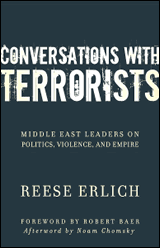
Defining what a terrorist is and isn’t is a major dilemma. What one may consider terrorism, another may consider resistance. So where does one draw the line? Reese Erlich tackles that topic in his latest book“Conversations with Terrorists: Middle East Leaders on Politics, Violence, and empire.”

Erlich is a veteran journalist who has covered U.S. foreign policy for decades. He has freelanced for National Public Radio, Radio Deutsche Welle, the Australian Broadcasting Corp. Radio, the Canadian Broadcasting Corp. Radio, and writes for The San Francisco Chronicle and The Dallas Morning News.
Drawing on firsthand interviews and original research, Erlich argues that yesterday’s terrorist is often today’s national leader and that today’s freedom fighter may become tomorrow’s terrorist. By branding all of American’s opponents as “terrorists,” it makes it more difficult to look beyond the individual or the political group and understand what they are really all about. I caught up with Erlich recently and here’s what he had to say.
What is your definition of terrorist and what is this term often misconstrued, misused, or inaccurately portrayed in the American mainstream media?

In the popular sense, it is anybody who uses violence you don’t like. So therefore al Qaida, Hamas, or Hezbollah are all terrorists whereas the Muhajahdeen fighting the Soviets in Afghanistan and the Contras in Nicaragua were freedom fighters. In my view, terrorism is the use of violence against civilians for political ends. Governments, insurgent groups, and individuals can commit terrorism. They are trying to impact political events by using violence against civilians.
Let’s use the example of the resistance in World War II. They sometimes blew up Nazi soldiers; sometimes civilians were killed inadvertently. But nobody would call them terrorists today because they were aiming at overthrowing the Nazi occupation in Europe and were not intentionally trying to kill civilians. I think we should use that same criteria when evaluating any insurgent group.

You write that government policies can also be acts of terrorism. How do governments commit acts of terrorism and how do you distinguish acts of terrorism versus acting in self-defense or protecting American foreign policy or national security interests?

In the book, I wrote that the CIA hired Saudi and Lebanese agents to try and kill Ayatollah Mohammad Fadlallah in Beirut in 1985. They planted a bomb, it went off, and 80-plus people were killed and many more were injured. Fadlallah escaped alive and uninjured, but many civilians died. The agents who did that on behalf of the CIA knew that civilians were going to be killed. So the deaths of many dozens of people was OK in their thinking of they could get one alleged terrorist.
Israeli officials do the same thing when they drop 500-pound bombs on apartment buildings in Gaza. They know that a lot of civilians were going to be killed. They make up stories about phoning people in advance, do Robocalls, and drop leaflets. They know perfectly well that civilians are going to do die but they figure it is worth it. They think if they can get this one Hamas leader, so what if a bunch of Palestinians die? Maybe they won’t support Hamas now. That’s terrorism.
What is the difference between how the western world views terrorism vs. its adversaries say North Korea, Iran, Afghanistan, Pakistan, Venezuela, Cuba, etc?

I think you have to make a distinction among different people. If you look at the communist countries, historically and today, by and large they don’t engage in terrorism. I wouldn’t say they’ve never engaged in a terrorist act, and they certainly engage in violent acts. According to Marxist theory, you alienate potential supporters by intentionally killing civilians. You should be going after military and political targets.
So many of the left-wing insurgent groups intentionally target military, corporate, and political leaders in a battle for power. That doesn’t mean I necessarily agree with them. But they are not terrorists.
If you look at Pakistan, India, or Egypt, on the other hand and depending on the government and the time frame we’re looking at, they sometimes did engage in terrorist tactics. Certainly military and intelligence sources associated with them have engaged in terrorist tactics. The 2008 Mumbai bombing was clearly a terrorist attack. It was designed to intimidate the Indian government by wreaking havoc among civilians and has been linked to the ISI intelligence service in Pakistan. Some of these U.S. allies engage in serious terrorist actions.
What is the difference between resistance and terrorism? How and why do these terms get confused?

The U.S. government vilifies anybody who takes up arms against the U.S. or its allies Everybody automatically becomes a terrorist. Some groups really are attacking civilians, like al Qaida. Others may have used terrorist tactics, but they are seen in their countries as legitimate national liberation groups, such as Columbian Marxist guerrillas (FARC), Hamas, Hezbollah, and the PLO for that matter. All of them have taken up arms and the U.S. condemns them as terrorists.
I have very sharp differences with Hezbollah and Hamas. They are, at the core, right-wing fundamentalist Muslim groups that want to come to power in their respective countries. I would never vote for them. But they are not mainly trying to kill civilians in order to seize power. They have certainly used violence and killed Israeli civilians and engaged in terrorist tactics, but they are viewed by their own people as national liberation groups.
In the case of Hezbollah, they are seen as the only group that is capable of militarily defending Lebanon against continued Israeli attacks. They have a lot of support among Lebanese Sunni Muslims, Christians and Druze.
Hamas won the 2006 elections fair and square in the Palestinian Authority, a little detail the U.S. and Israel likes to forget about. So it does no good to simply vilify them as terrorists. You have to deal with them politically. What do they stand for? Why not sit down and negotiate with them?
In your book, you meet with individuals that many western foreign leaders/governments consider to be terrorists. For instance, you talk with Hamas leader Khalid Meshal. The U.S. considers Meshal and especially Hamas a terrorist organization. How is Meshal and Hamas misportrayed by American government elites and or the mainstream media?

I spend a fair amount of time going into Hamas in the book. It began as a distinctly rightwing fundamentalist group that was tolerated by Israel because Israeli authorities wanted to split the Palestinians at the time, and they saw the PLO as the main danger. But Hamas has evolved and developed a sizeable base of support, as reflected in the elections. But then they faced the problem of “How do you actually govern?”
A lot of their fundamentalist ideology didn’t work because the Palestinians, at their core, are secular. They aren’t interested in a fundamentalist government running them like in Iran or Saudi Arabia. The U.S. and Israel at that time should have acknowleged the changes in Hamas. It wasn’t the Hamas of 20 years ago. There could have been some major breakthroughs.
All you have to do is look at the history of the PLO. I remember when Yasser Arafat was the “chief terrorist,” when Israeli leaders called him another “Hitler.” The PLO began advocating a two-state solution in the early 1980s. But the U.S. and Israeli refused to negotiate the the PLO “terrorists.” Then boom, the late Prime Minister Yitzhak Rabin comes into power and is willing to negotiate. Suddenly, they acknowledge what the PLO had been saying for 10 years. They sat down and negotiated the Oslo Accords. The same thing eventually is going to happen with Hamas.
Suddenly some Israeli politician is going to make a 180-degree turn and realize that Hamas isn’t the horrible group they have been vilifying, and Hamas is willing to negotiate a two-state solution. Meshal made that clear to me, to former president Jimmy Carter, and numerous other people — contrary to all the propaganda in the United States. Under certain circumstances Hamas would accept a two-state solution and agree to a long-term ceasefire with Israel.
Recently, some militant members of Hamas killed settlers in Hebron. Were those acts of terrorism and how do you respond to that incident? How can we view that incident accurately and appropriately?

This is where I disagree with Hamas. They see all of these things as acts of resistance. I don’t. I think there is a distinction between waging a guerrilla war against soldiers and political leaders and simply killing people because they are Israelis. Sometimes Hamas makes that distinction and sometimes it doesn’t.
But what about the argument that the settlers are akin to Israel’s reserve army because they are given weapons to use and what not?

I’ve been in Hebron. Some of these folks are armed occupiers and are no different from the military. I think that is true. I think if you went to other places like Ariel or other settlements, basically you have secular people who are looking for cheap housing and the Israeli government provides cheap mortgages for expanding suburbs. So I think Hamas should make that distinction.
CNN anchor Octavia Nasr was recently fired for expressing sympathy or remorse over the death of Grand Ayatollah Mohammad Fadlallah. How and or why is he and Hezbollah misportrayed in the American media and based on your experiences what is the truth of Fadlallah and/or Hezbollah?

In Lebanon, Fadlallah was considered a moderate on many issues. In the book I quote Lebanese leader Walid Jumblatt, who has gone to war with Hezbollah at various times. Hesaid Fadllalah was quite moderate in many of his policies. He is not Hezbollah’s spiritual advisor. He never was. He saw himself as a Muslim cleric who was trying to unite Muslims of all different political and religious tendencies. On domestic issues, he was in favor of women’s rights and democracy in Lebanon. He issued a fatwa against smoking and upheld science against superstition. Nasr was simply reflecting the widespread sentiment in much of the Arab world.
What other examples of terrorism stands out that Americans do not hear about or receive false information? What do Americans need to unlearn when it comes to terrorism and terrorist organizations?

There is a whole dirty war, basically death squads promoted by the United States around the world. They are called Special Operations. They engage in terrorist tactics. Imagine for a moment that an enemy of the U.S. decided to come into U.S. territory with undercover agents, to kidnap, torture, and imprison American citizens that it considered dangerous. Can you imagine the outrage inside the U.S.? But the U.S. does that. It was done very widely under George W. Bush, but it continues under Barack Obama. The Obama Administration defends it. Look at the most recent court decision not allowing any court hearing for people who were tortured by the U.S. or sent to countries to be tortured.  I think that is an important story that needs to be told.
What do people need to unlearn? I think as a practical matter, stop calling people or groups “terrorists.” Just accurately describe what they are doing and what they believe. Then let people decide whether they like them or not. Just stop throwing around the epithet ‘terrorist.’

Saturday, September 25, 2010

The Obama Syndrome - Interview with Tariq Ali

"Surrender at Home, War Abroad"


We speak with British Pakistani political commentator, writer, 
activist and editor of the New Left Review, Tariq Ali
He is the author of numerous books; 
his latest is The Obama Syndrome
Surrender at Home, War Abroad.

AMY GOODMAN: Coming up, Glenn Greenwald joins us, usually in Brazil, but here he’s in New York. But right now we’re staying with Tariq Ali. He has a new book out; it’s called The Obama Syndrome: Surrender at Home, War Abroad. Some might say that’s a little harsh.

TARIQ ALI: I know some of his supporters might feel it’s a little harsh, but I think that we’ve had two years of him now, Amy, and the contours of this administration are now visible. And essentially, it is a conservative administration which has changed the mood music. So the talk is better. The images of the administration are better, the reasonable looks. But in terms of what they do—in foreign policy, we’ve seen a continuation of the Bush-Cheney policies, and worse, in AfPak, as they call it, and at home, we’ve seen a total capitulation to the lobbyists, to the corporations. The fact that the healthcare bill was actually drafted by someone who used to be an insurance lobbyist says it all.

So, it’s essentially now a PR operation to get him reelected. But I don’t think people are that dumb. I’ve been speaking to some of his, you know, partisan supporters, and they’re disappointed. So the big problem for Obama is that if you do nothing and promise that you would bring about some changes, you will not have people coming out to vote for you again. And building up the tea party into this great bogey isn’t going to work. It’s your own supporters you have to convince to come out and vote for you, as they did before. I can’t see that happening.

AMY GOODMAN: The cover of your book, The Obama Syndrome: Surrender at Home, War Abroad, is a picture of the face, the head of President Obama, and half of it is peeled away to reveal President Bush.

TARIQ ALI: Well, this, you know, I think, is a sort of very brilliant West Coast montage artist, and they are the best. Whenever there’s a crisis, they come up with an image which says it all. And I like that image a lot, and I used it very deliberately to show the continuation, that it’s not a case that we have a new administration. We do, technically, but it’s continuing with many of the old policies in the—how it deals with the economy. When you have people like Krugman, Joseph Stiglitz, occasionally Frank Rich in the New York Times, Maureen Dowd, these people who were desperate for a Democrat administration being incredibly critical of some of its things, when you have venerable professors like Gary Wells saying, "I’m disappointed," the honeymoon didn’t last long with Obama. It lasted much, much longer with Clinton. And one reason for that is that he had raised hopes and was unable to deliver. He turned out to be an apparatchik and a political operator from one of the worst Democrat areas in the country, Chicago, and that’s what he behaves like.

AMY GOODMAN: Robert Gibbs, the White House press spokesperson, going after the so-called "professional left"? Your thoughts?

TARIQ ALI: Well, I mean, it’s interesting that they are incapable of dealing with the right. With the right, it’s conciliation. That’s what they feel they have to appeal to. With critics from the left, they tend to be very harsh, as if they are saying to us, "You don’t know how lucky you are." But why are we lucky? I mean, you know, we judge people not by how they look or what they say, but by what they do. And what Obama has been doing is, you know, to put it mildly, extremely disappointing at home, and abroad it’s murderous. On Palestine, on Iran, no changes at all. So, one has to spell this out, because if they don’t realize that they’re doing this, they’re going to get more shocks. And Rahm Emanuel refers to people on the liberal left who are critical of Obama, and he uses a bad swear word and then says, "effing retards"—well, we’ll see who the retards are after the midterms, Amy. That’s all I can say.

AMY GOODMAN: Surrender at Home, War Abroad You were born in Pakistan. You ultimately went to Britain, where we just came from last night. It’s been interesting to see the politics there, but also the devastation of the war, the effects of the wars, on the population at home in Britain. A report in the paper the other day, when we were in London, saying that 20,000 veterans are in prison, mainly Iraq, Afghanistan war veterans, for committing violent and sexual crimes. But what about the war abroad and what President Obama is doing—says he’s scaling back Iraq, still about 50,000—actually, well more than that—military, and you could say paramilitaries with a mercenary armies there, and in Afghanistan, the surge?

TARIQ ALI: Well, I mean, again, let’s look at it concretely. Bush had promised exactly the same withdrawal pattern from Iraq: by this time, we will be out. Obama has followed it. They’re not going out. What is essentially happening, they’re reducing the presence of combat troops and eliminating it in the big cities, and building six huge military bases all over Iraq, in which they’ll keep between fifty and sixty thousand soldiers, ready to act when the need be—just like the British did when they occupied Iraq in the '20s and ’30s of the last century. And the British were then driven out by a violent upheaval and revolution in the ’50s. So the US is keeping these bases in, (a) to control Iraq, and (b) as a warning to Iran. And I think there's going to be trouble. 
The war isn’t over at all. We’ve seen, just a few days ago, huge explosions in Baghdad and Fallujah. It’s a total disaster and a mess. And to present that as somehow "mission accomplished part two" is a joke. That country has been wrecked, a million Iraqis dead, its social infrastructure destroyed. And in Afghanistan, they are now going from bad to worse. They know, and General Eikenberry knows and says, we cannot win this war militarily. They can’t lose it, but they can’t win it, either. So, political solution is the only way out, and that means that they have to have an exit strategy. Obama isn’t even talking about that, because that might be construed as a sign of weakness. But by who? The army knows what’s going on. They can’t stay there forever.

AMY GOODMAN: It was quite astounding, with the tremendous attention on Terry Jones threatening to burn a Quran, a horrific symbol all over the world, as it would be for any religious book, but at the same time, what was coming out of Afghanistan, a report of a kill team—this is a US kill team—who was taking souvenirs of fingers and other body parts, that getting very little attention in terms of what it means for not just the Muslim community, but for people all over the world.

TARIQ ALI: But, you know, Amy, some of us who are sort of elderly now remember exactly the same things happening in Vietnam during that war, where there were lots of report—in those days publicized much more, I have to say—of US soldiers in Vietnam taking trophies, which were parts of bodies of Vietnamese dead or who they had killed or tortured to death.

AMY GOODMAN: And just this report we read today, Michael Ware, well known face on CNN, constantly on talking about Iraq 
TARIQ ALI: Exactly.

AMY GOODMAN: —saying when he had this footage of a US soldier killing an Iraqi teen, they did not allow him to run that footage. And CNN owns it, so he can’t get it.

TARIQ ALI: It’s a disgrace that CNN did that, but that is a sign of how the global media corporations have been reporting the wars in Iraq and Afghanistan. Self-censorship has been the order of the day. They haven’t wanted to offend the US military, in sharp contrast to how the Vietnam War was covered. I remember Morley Safer on CBS News reporting a family’s home being destroyed by US Marines and Safer commenting, "We’re fighting for freedom." That sort of stuff is not permitted now. The global corporations don’t do it, which is why programs like this are important. But now that if he can’t even use the footage that he took, what is that? I mean, how people in that part of the world know exactly what’s going, and it’s not the Quran burnings that upset them so much—but they do, too—but what is happening to their daily lives with the US and NATO presence. That is what upsets them, and that is the root of the problem.

AMY GOODMAN: You know, we were just in London and saw a production that’s based on Howard Zinn’s A People’s History of the United States, but it’s The People Speak. It’ll air on History Channel UK on October 31st, a remarkable production of British people’s history. And one of the people who is portrayed there was you, talking about "Blair-faced liars." But you have a long history of decades of organizing around global politics in Britain. What about solutions right now? I mean, you have this One World March that’s going to be taking place on October 2nd in Washington, DC, based on jobs, justice and education. What about the kind of organizing that you feel is the most effective? People say, well, what should Obama do? What should Obama do? He is one person, albeit occupies the most powerful position on earth. But isn’t it really about movements, pressuring these individuals? That’s what makes history.

TARIQ ALI: I agree with you entirely. And I remember saying to lots of activists in the United States during the Obama election campaign—you know, people mobilized by MoveOn.org, etc.—and I would say to them, "Fine. You’re campaigning for Obama. You want him elected. OK, good. Let’s hope he delivers what you hope he’s going to deliver. But he’s not going to deliver even that if you just elect him and go back home." And I remember arguing for a massive antiwar gathering for the inauguration, which would pressure right from day one on the new administration, saying, "Congrats, Barack. Now out of Baghdad and Iraq. Out of Kabul and Afghanistan," from the word go. Without that, politicians don’t do anything. We wouldn’t have won any democratic rights, unless people had fought for them. The right of women to vote would never have been got, unless there’d been suffragettes fighting for it. So, that is the lesson, I’m afraid. And, you know, when people tell me in this country, "Oh, but there’s pressure from these kooks on the right, the tea party and this and that," I said, "Obama boasts, and his office boasts, that they have 13 million supporters online. Well, what the hell are they doing with them? I mean, why couldn’t they mobilize even a tiny proportion of these to come out and give them support?" They don’t do that. So, someone has to do it.

AMY GOODMAN: Or they’re there and the media doesn’t cover them. When you had one of the tea party rallies in Washington—I believe it was right on the anniversary of the war—there were about 500 members of the tea party there. There were thousands of people protesting the war. It got almost no coverage, certainly not equal to what happened with the tea party.

TARIQ ALI: Exactly. So the exaggerated threat of the tea party is played up by the right-wing media, Fox and many others, because they see it as a useful way to hammer the administration. But the administration’s inability to take them on in terms of arguments, that is what’s worrying, Amy.

AMY GOODMAN: Well, Tariq Ali, I want to thank you for being with us. We’re going to talk about the tea party with Glenn Greenwald. Tariq Ali, The Obama Syndrome: Surrender at Home, War Abroad is the name of his new book.